

At MJM Industries, every cable assembly we produce undergoes hipot testing to ensure our customers receive reliable, safe products. In this post, we’ll answer three key questions: what hipot testing is, why it’s important, and how we perform this type of electrical safety test. Keep reading to learn the answers to these questions and more.
What Is Hipot Testing and Why Is It Important?
Hipot testing, short for “high potential” testing and also called dielectric withstand testing (DWT), is a safety test designed to verify the integrity of electrical insulation. It is an integral part of electrical and electronic equipment manufacturing. The hipot test is the most common type of electrical safety test. It works by stressing the unit’s insulation far beyond what it would encounter during normal use. If the insulation can withstand that much higher voltage without breaking down, you can trust it to perform safely at normal operating voltages.
A hipot test is performed by applying high voltage between parts of the device that should be electrically isolated from each other, such as between a conductor and the chassis. For a cable assembly, that typically means testing between each conductor and every other conductor, as well as between the conductors and any shield. During the test, the tester measures the leakage current that flows through the insulation. If that current stays below a set limit and no breakdown (arc-over) occurs, the part passes.
In addition to verifying insulation, hipot testing can identify manufacturing defects such as:
- Pinched wires
- Stray wire strands
- Poor electrical clearance between conductors or terminals
- Damaged or nicked insulation
At MJM Industries, high-voltage withstand tests are performed to ensure that short circuits will not occur in any of the custom cable assemblies we produce. In order to pass the test, our products must have a dielectric withstand voltage of at least 300V RMS @60 HZ/ 250V AC/ 1 min.
How Do We Perform Hipot Testing for Our Cable Assemblies?
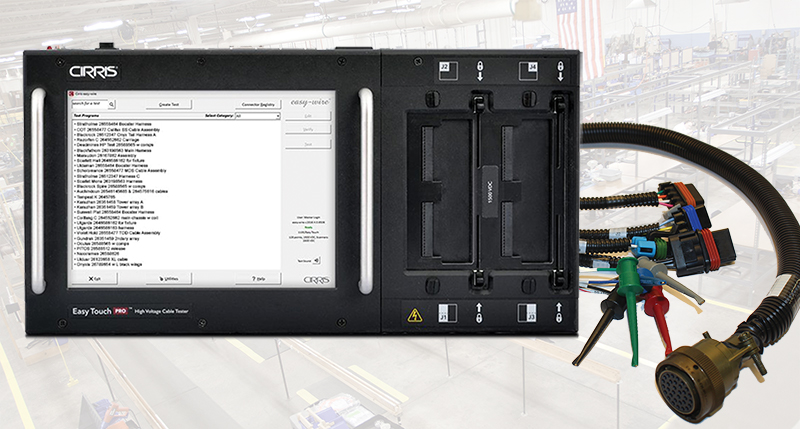
At MJM Industries, we perform all of our dielectric testing using Cirris test machines. More specifically, we currently use the Cirris Easy-Touch Pro.
The Cirris Easy-Touch Pro is a high-voltage tester with a built-in Windows operating system. It was designed to integrate easily into the manufacturing process and tests for opens, shorts, and miswires. This self-contained, high-voltage cable tester also measures resistance and verifies solder and crimp terminations. Because the same machine performs hipot and continuity testing, each cable is assembly is checked for insulation integrity and correct wiring before it ships.
Why Choose MJM Industries for Dielectric Withstand Testing?
MJM Industries can perform both AC and DC hipot testing. AC hipot testing stresses insulation in both polarities and closely simulates real-world AC operating conditions, while DC hipot testing produces lower leakage current readings and is often preferred for longer cables or assemblies with higher capacitance. We can also adjust how long the high voltage is applied to each cable and the frequency of the AC waveform.
With a configurable test unit such as the Easy-Touch Pro, we can meet each customer’s specific dielectric withstand testing requirements. Our test equipment records the results and can print copies of each test report, giving you documented proof that your cable assemblies passed.
Our Hipot tested products are trusted by customers in a wide variety of industries, including:
- Automotive
- Aerospace
- Mass transit
- Consumer products
- Industrial automation
- Flat-panel display
- Test and measurement
- Defense and military
- Machine control
- Water treatment
- Appliance
- Medical
- Retail display
Contact MJM Industries for Hipot-Tested Cable Assemblies
If you are looking for dependable cable assemblies that undergo Hipot testing, you can count on MJM Industries. Our team of industry experts delivers high-quality products, innovative manufacturing, intelligent engineering, and remarkable customer service.
Contact MJM Industries today to get started! We are ready to work with you.
