
Larger Cable, Same M12 Interface: When to Consider M12 XL
Cable assembly design starts with the requirements of the application. Electrical performance, conductor count, shielding, environmental protection, communication requirements, and mechanical demands all influence the cable construction ultimately specified.
In some applications, those requirements result in a larger or more specialized cable construction. The M12 electrical and mating interface remains unchanged; the constraint is the cable’s outside diameter or construction, which may exceed what a standard M12 overmold can practically accommodate.
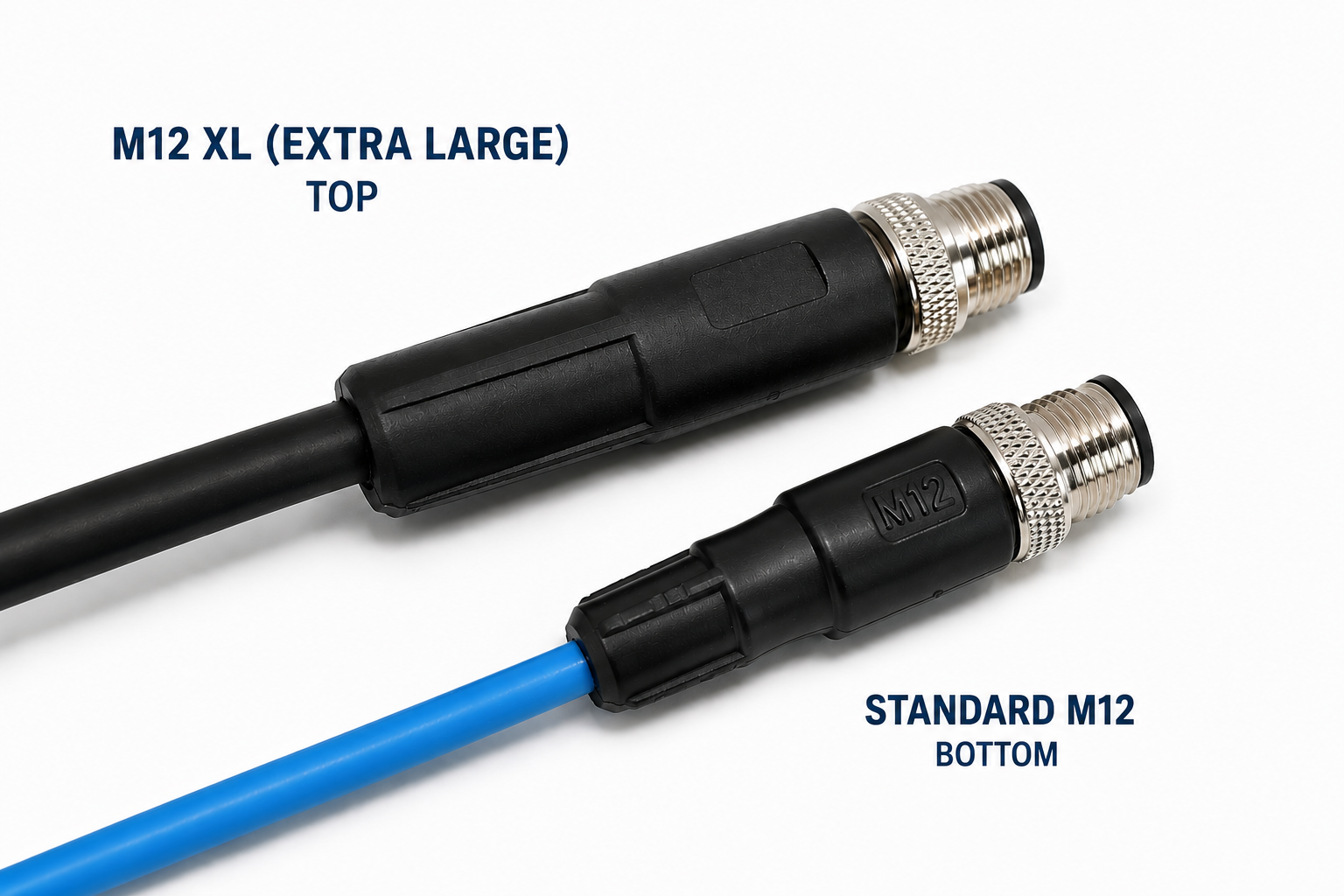
That’s where the M12 XL provides another option. By retaining the industry-standard M12 electrical and mating interface while incorporating a larger overmolded body, the M12 XL can accommodate larger cable constructions while providing the additional strain relief and mechanical support they may require.
This article explores the application and cable considerations that may point toward an M12 XL, how it differs from a standard M12 assembly, and when maintaining the M12 interface can help avoid an unnecessary change in connector platform.
Why Cable Construction Matters
Application requirements can affect more than a cable’s electrical performance. Conductor count, shielding, armor, jacket construction, communication requirements, and other forms of mechanical or environmental protection can also influence the cable’s overall construction and outside diameter.
The key consideration isn’t whether an application uses a particular cable category or technology. It’s whether the cable specified for that application can be properly supported within the physical constraints of a standard M12 overmold.
When it can’t, engineers need to determine whether the M12 interface itself needs to change—or whether the cable simply requires a different overmold solution.
When the Overmold Becomes the Constraint
When a larger cable construction is required, the design constraint is not the M12 electrical and mating interface; it is whether the standard overmold can physically accomodate and support the cable. Engineers should evaluate:
- Does the M12 interface still satisfy the application’s electrical and mating requirements?
- Is the cable construction creating a physical constraint for the standard M12 overmold?
When the M12 mating interface continues to meet the application’s requirements and the primary limitation is the cable’s size or construction, changing connector platforms may not be necessary. An M12 XL can provide the additional space and mechanical support needed to accommodate the cable while maintaining the established M12 interface.
Design Consideration
Separating the electrical requirements from the physical packaging requirements can help avoid introducing unnecessary complexity into the assembly. If the interface is already doing its job, the better solution may be to adapt how the cable is supported rather than redesign the connection.
The M12 XL: Supporting Larger Cable Constructions
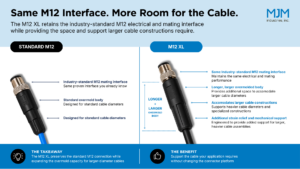
The key difference between a standard M12 assembly and an M12 XL is the overmolded body. The M12 XL retains the industry-standard M12 electrical and mating interface but incorporates a longer, larger overmold designed to accommodate cable constructions that require more physical space.
The expanded overmold provides additional room to support larger cable diameters while also allowing for increased strain relief and mechanical support. This can be especially important with heavier or more complex cable constructions, where the cable-to-connector transition needs to be properly supported.
Because the electrical and mating interface remains M12, the M12 XL expands the physical capabilities of the assembly without requiring a change to the established connector interface.
When Should You Consider an M12 XL?
Once the cable has been specified for the application, several physical and mechanical considerations can help determine whether a standard M12 overmold can adequately support the assembly or whether an M12 XL should be evaluated.
Consider:
- Cable outside diameter: Can the specified cable be properly accommodated within the standard overmold?
- Cable construction: Do shielding, armor, conductor count, jacket construction, or other design requirements add bulk or complexity at the termination?
- Strain relief: Does the cable’s size, weight, or construction require additional support at the cable-to-connector transition?
- Mechanical demands: Will installation or operating conditions place additional stress on the cable assembly?
- Overmold capacity: Can the standard M12 overmold provide the space and mechanical support required tby the specified cable?
If the M12 interface remains appropriate but the specified cable creates physical or mechanical constraints for a standard overmold, an M12 XL may be worth evaluating.
Where M12 XL Can Add Value
The physical and mechanical requirements that lead engineers to evaluate an M12 XL can arise across a range of industries and applications.
Examples include:
- Rail and transit
- Heavy equipment
- Commercial vehicles
- Agriculture
- Industrial automation
The industry itself isn’t what determines whether an M12 XL is the right solution. The decision comes back to the specific application, the cable construction it requires, and whether that construction can be properly supported within a standard M12 overmold.
Engineering Around the Application
Selecting the right cable assembly means looking beyond the connector alone. Electrical requirements, operating environment, cable construction, installation constraints, and mechanical demands all influence the final design.
At MJM Industries, those requirements guide every recommendation—whether the right solution is a standard M12 assembly, an M12 XL, or a fully custom cable assembly. By evaluating the complete assembly, MJM helps customers identify a solution that supports the application without introducing unnecessary complexity.
Ready to Find the Right Solution for Your Application?
When your application requires a cable construction that pushes the physical limits of a standard M12 overmold, changing connector platforms isn’t necessarily the only option.
Contact the MJM Industries team to discuss your application requirements and determine whether a standard M12 assembly, an M12 XL, or a custom cable assembly provides the right combination of electrical performance, mechanical support, and fit for your application.