
Improving Manufacturability for Complex Aerospace Cable Assemblies
An aerospace cable assembly design can meet an application’s functional requirements and still present challenges when it reaches production. Wire routing, conductor preparation, assembly processes, and testing requirements can affect whether an assembly can be manufactured efficiently, consistently, and to the required quality level.
For one aerospace application, MJM Industries used design for manufacturability (DFM) to address those challenges without changing the customer’s proprietary system design. The result was a more repeatable manufacturing process, easier downstream integration, improved delivery performance and, ultimately, a significantly larger share of the customer’s cable assembly program.

The Application: Custom Aerospace Cable Assemblies for a Cargo System
MJM Industries learned about the project through a printed circuit board (PCB) subcontractor working with an aerospace integrator. The application involved a skid loading system installed within the fuselage of jets used to transport goods.
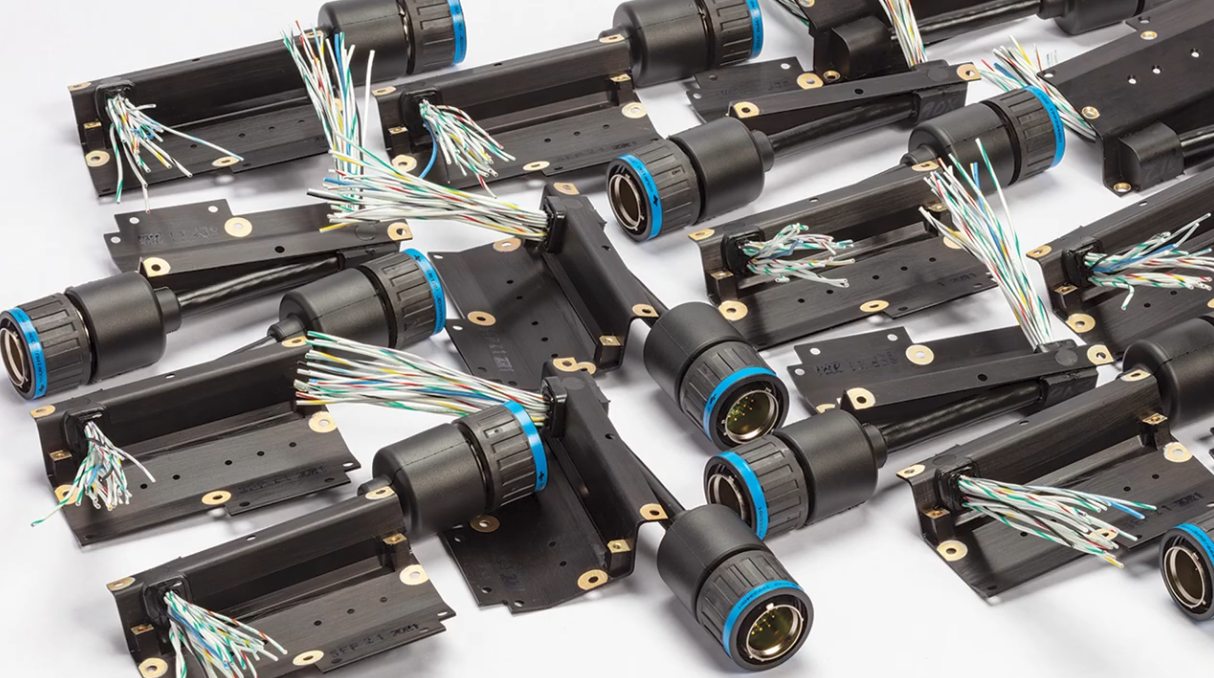
Approximately 200 custom aerospace cable assemblies were installed in each cargo hull as part of the system used to load and lock down skids before transport. The assemblies incorporated aerospace connectors, an aluminum grounding plane, and a custom composite cable.
The application also carried demanding quality and testing requirements, including Class 3 wire processing and high-current testing.
The Challenge: Quality and Delivery Problems Were Limiting Production
Two cable assembly manufacturers were already vendors of record for the program, but both were experiencing quality and delivery issues. MJM Industries was initially brought in as a third supplier to help increase output.
As the MJM Industries engineering team worked through the manufacturing requirements with the customer, they identified challenges that extended beyond production capacity.
The PCB was attached to an aluminum ground plane in a configuration that required conductors from the cable to terminate on both the top and bottom sides of the board. With the existing cable construction, the PCB subcontractor had difficulty getting individual wires into the correct positions and maintaining the necessary wire lengths for soldering. Wires had to cross over one another or be trimmed during integration, adding labor and complexity to the assembly process.
There was also a quality concern with the small-gauge conductors. Other suppliers were nicking wires and cutting strands during wire stripping, creating the potential for conductor damage.
The challenge wasn’t simply building the assembly. It was finding a more repeatable way to manufacture it while reducing the work required during integration.
The Solution: Applying Design for Manufacturability to the Cable Assembly
Rather than changing the customer’s system design, MJM Industries applied DFM principles to determine how the cable construction and production process could better support it.
Positioning Conductors for Easier PCB Integration
MJM Industries worked with the cable manufacturer to control the position of the conductors within the custom composite cable. Each wire was oriented based on whether it needed to terminate on the top or bottom side of the PCB.
With the conductors already positioned for their intended termination locations, the PCB subcontractor could eliminate unnecessary wire crossover and trimming while simplifying soldering. The solution improved manufacturability at MJM Industries while also reducing labor during the customer’s integration process.
Protecting Small-Gauge Conductors With Class 3 Laser Stripping
MJM Industries also addressed the conductor damage occurring during wire preparation.
Using Class 3 laser stripping equipment allowed MJM Industries to remove insulation without the mechanical contact associated with conventional stripping methods, eliminating the nicked wires and cut strands the program had experienced with the small-gauge conductors.
Together, these changes provided a more controlled and repeatable approach to producing the assemblies.
The Results: From Third Supplier to Majority Share of the Program
MJM Industries entered the program as an additional source intended to help address output limitations. Within 12 months, the company had secured approximately 80% to 90% of the cable assembly contract.
The improved manufacturing approach helped provide:
- Greater labor efficiency
- Improved on-time delivery to the end customer
- Consistent, level-loaded weekly shipments
- 100% electrical testing
- More repeatable cable assembly production
- Reduced risk of conductor damage
- Easier assembly and integration
The growth of MJM Industries’ share of the program demonstrated the value of Design for Manufacturability. By identifying opportunities within the cable construction and production process, MJM Industries helped address challenges affecting quality, delivery, and the customer’s own production process.
Custom Aerospace Cable Assembly Manufacturing Capabilities
Aerospace cable assemblies can require specialized materials, processes, testing, and quality standards. This project drew on several of MJM Industries’ manufacturing capabilities, including Class 3 processing, laser stripping, overmolding, IPC/WHMA-A-620 requirements, high-temperature capabilities, and electrical testing.
MJM Industries also has experience manufacturing military-style connector and cable assemblies and is an ITAR-registered U.S. contract manufacturer.
Combined with in-house engineering and broad cable processing capabilities, that experience allows MJM Industries to work collaboratively with customers when demanding aerospace and defense applications require more than simply following a drawing.
Production-Ready Aerospace and Defense Cable Assemblies
Customers don’t always need a manufacturing partner to redesign their product. Sometimes, they need a partner that understands how to design for manufacturability.
MJM Industries works alongside engineering, production, and procurement teams to identify manufacturability considerations and develop practical solutions for producing reliable custom aerospace cable assemblies and other cable and wire assemblies for demanding applications.
Have a cable assembly that’s creating manufacturing, quality or integration challenges? Talk to MJM Industries about your application.