
When configuring an M8 or M12 cable assembly, material selection should be driven by the application. The right solution comes from selecting a combination of materials that work together to meet the application’s electrical, mechanical, and environmental demands.
One of the most common challenges is accurately evaluating the operating environment before materials are selected. Temperature, moisture, chemical exposure, movement, and electrical requirements can all influence the finished cable assembly.
Every component contributes to the assembly’s performance, but no material should be evaluated in isolation. The cable jacket, overmold, O-ring, coupling nut and shielding must work together to support long-term performance.
Our engineering team evaluates how each component contributes to the performance of the complete cable assembly rather than treating material decisions independently.
The sections below outline the key material decisions involved in specifying an M8 or M12 cable assembly.
Begin with the Application Requirements
Before selecting materials, define the conditions the cable assembly will experience throughout its service life.
Key considerations include:
- Temperature range and operating conditions
- Indoor or outdoor installation
- Water and moisture exposure
- Required ingress protection (IP) rating
- Oils, chemicals and cleaning agents
- UV exposure
- Continuous flex versus stationary installation
- Abrasion and mechanical wear
- Washdown or sanitary requirements
- EMI and shielding requirements
- Industry-specific standards or approvals
A cable assembly installed inside a control cabinet faces very different demands than one used on constant motion automation equipment, exposed to outdoor elements, or in a washdown environment. Defining those requirements first provides the foundation for every material decision that follows.
Decision #1: Selecting the Right Cable Jacket
The cable jacket protects the conductors from environmental exposure and mechanical damage, making it one of the most influential material decisions in the assembly’s long-term performance.
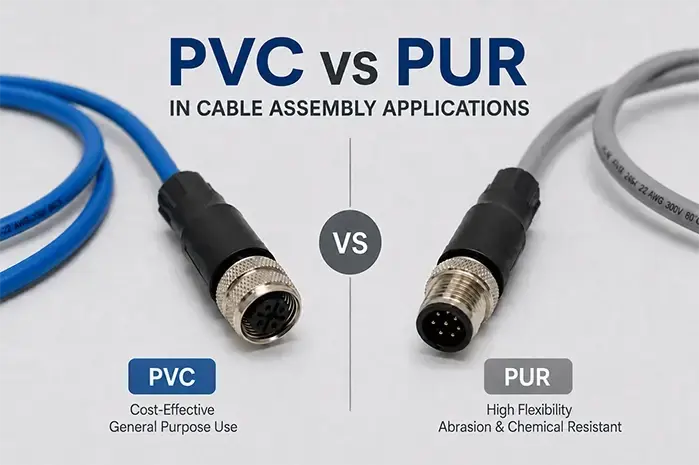
For M8 and M12 cable assemblies, the two most common jacket materials are PVC (Polyvinyl Chloride) and PUR (Polyurethane).
PVC
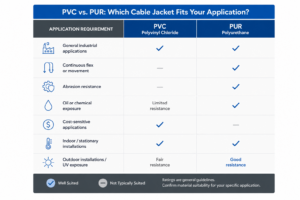
PVC is a versatile, cost-effective material that performs well in many general industrial environments. It provides good electrical insulation and moisture resistance, making it well suited for stationary applications where continuous flexing, aggressive chemicals, or severe abrasion are not primary concerns.
PUR
PUR is commonly selected where increased resistance to abrasion, oils, repeated flexing, or certain chemical exposures is required. These characteristics make it well suited for dynamic applications and demanding industrial environments where long-term durability is a priority.
Engineering Takeaway
Selecting a cable jacket isn’t about choosing the “better” material—it’s about selecting the material that best matches the application’s operating conditions.
Using PUR in a stationary indoor application may increase cost without improving performance, while specifying PVC for continuous-flex or aggressive environments can reduce long-term service life.
Selecting the right cable jacket is only part of the material decision. The cable-to-connector transition must also withstand the application’s mechanical and environmental demands, making overmold selection the next critical consideration.
Decision #2: Matching the Overmold to the Cable Jacket
The overmold protects one of the cable assembly’s most vulnerable areas: the transition between the cable and the connector. Beyond providing a finished appearance, it creates strain relief, helps maintain the environmental seal, and protects the termination point from mechanical stress.
Like the cable jacket, overmolds are most commonly manufactured from PVC or PUR. The most important consideration isn’t choosing one material over the other—it’s selecting an overmold that is compatible with the cable jacket.
PVC Overmolds
PVC overmolds are typically paired with PVC cable jackets to create a reliable bond between the cable and overmold while providing effective strain relief and environmental sealing. This combination offers a cost-effective solution for many general industrial applications where PVC performance characteristics meet the application’s requirements.
PUR Overmolds
PUR overmolds are typically paired with PUR cable jackets to create a compatible bond while supporting the abrasion resistance, chemical resistance, and continuous-flex performance required in more demanding operating environments.
Compatibility Matters
The overmold material should match the cable jacket material. Incompatible materials may not bond properly, which can compromise sealing performance and expose the termination to moisture, chemicals, and mechanical stress.
With the cable-to-connector transition protected, the next consideration is selecting an O-ring material that maintains the connector’s environmental seal.
Decision #3: Selecting the Right O-Ring Material
The O-ring is one of the smallest components in an M8 or M12 cable assembly, but it plays a critical role in maintaining the connector’s environmental seal. Selecting the appropriate material helps protect the connection from moisture and contaminants while supporting the required ingress protection (IP) rating when mated.
Operating conditions determine the appropriate sealing material. The most common options include NBR (Nitrile), FKM (Fluorocarbon), Silicone, and EPDM.
NBR (Nitrile)
NBR is commonly used for general industrial applications where resistance to oils and fuels is required.
Typical applications include:
- General industrial equipment
- Oil and fuel exposure
- Standard operating environments
FKM (Fluorocarbon)
FKM provides increased resistance to chemicals and elevated temperatures, making it well suited for more demanding industrial environments.
Typical applications include:
- Chemical exposure
- High-temperature environments
- Harsh industrial applications
Silicone
Silicone maintains flexibility across a broad temperature range, making it useful where temperature extremes are a primary design consideration.
Typical applications include:
- High- and low-temperature environments
- Applications requiring flexibility across varying temperatures
EPDM
EPDM provides strong resistance to water, steam, and weathering, making it a good choice for applications with significant environmental exposure.
Typical applications include:
- Water exposure
- Outdoor environments
- Weather-resistant applications
Reliability Consideration
O-ring failures aren’t always immediately visible.
A seal may appear intact while gradually losing its ability to prevent moisture ingress.
Selecting an O-ring based on the application’s operating environment—not simply reusing a previous specification—helps maintain sealing performance throughout the life of the cable assembly.
Maintaining the environmental seal is only one part of long-term connector reliability. The next decision is selecting a coupling nut material that can withstand the application’s mechanical and environmental demands.
Decision #4: Choosing the Right Coupling Nut Material
The coupling nut secures the connector to its mating interface, making it an important contributor to long-term mechanical performance. Material selection should balance corrosion resistance, durability, weight, and the application’s operating requirements.
The three most common coupling nut materials are nickel-plated brass, stainless steel, and engineered plastic.
Nickel-Plated Brass
Nickel-plated brass provides a balance of durability, corrosion resistance, and cost, making it a common choice for many industrial applications.
Common applications include:
- General industrial automation
- Indoor manufacturing environments
- Applications requiring a balance of durability and cost
Stainless Steel
Stainless steel is commonly selected where increased corrosion resistance is required, particularly in environments involving moisture, chemicals, or frequent washdowns.
Common applications include:
- Washdown environments
- Food and beverage processing
- Chemical exposure
- Corrosive operating conditions
Engineered Plastic
Engineered plastic offers a lightweight alternative where corrosion resistance or reduced weight is an important consideration.
Common applications include:
- Lightweight equipment
- Corrosion-resistant applications
- Applications where reduced weight is preferred
Selection Consideration
Corrosion resistance is only one factor when selecting a coupling nut material. Mechanical durability, installation requirements, weight, and the operating environment should all be considered to identify the material that best supports the performance requirements of the complete cable assembly. Mechanical reliability is only one part of cable assembly performance. In electrically noisy environments, the next consideration is protecting signal integrity through appropriate shielding.
Decision #5: Determining the Appropriate Shielding
Not every M8 or M12 cable assembly requires shielding. In environments with significant electromagnetic interference (EMI), selecting the appropriate shielding can be critical to maintaining reliable signal transmission.
Shielding helps protect signal conductors from external electrical noise that can interfere with communication and overall system performance. The appropriate shielding strategy depends on the electrical environment and the performance requirements of the application.
The most common shielding options include foil shielding, braided shielding, or a combination of both.
Foil Shielding
Foil shielding provides excellent coverage against high-frequency electromagnetic interference while maintaining flexibility. It is commonly used where consistent signal performance is required, and the cable is not subjected to repeated flexing.
Braided Shielding
Braided shielding provides additional mechanical durability while offering effective protection against lower-frequency interference. It is often selected for cable assemblies that experience movement or mechanical stress.
Combination Shielding
Some cable assemblies use both foil and braided shielding to provide broader EMI protection across a range of operating conditions. Combining both methods allows designers to take advantage of the strengths of each when additional signal protection is required.
Shielding Consideration
Higher rated shielding doesn’t automatically result in better performance.
The appropriate shielding strategy depends on the level and type of electrical noise the cable assembly will encounter. Matching the shielding approach to the electrical environment helps maintain signal integrity without adding unnecessary complexity.
The MJM Industries Approach
Selecting materials for an M8 or M12 cable assembly is rarely about optimizing a single component. Long-term performance depends on how every material works together as part of the complete assembly.
At MJM Industries, cable jackets, overmolds, O-rings, coupling nuts, shielding, and termination methods are considered together—not independently. Looking at the complete assembly helps identify material combinations that support the application’s electrical, mechanical, and environmental requirements while balancing manufacturability and long-term performance.
Whether adapting an existing design, or developing a new cable assembly, involving engineering early in the design process can help identify material considerations before they become production or field-performance challenges.
Conclusion
Ready to Select the Right Materials for Your Cable Assembly?
Whether you’re designing a new application or refining an existing one, MJM Industries can help you evaluate material options and engineer a cable assembly built around your performance requirements.
Contact our team to discuss your project and identify the right material combination for your application.