
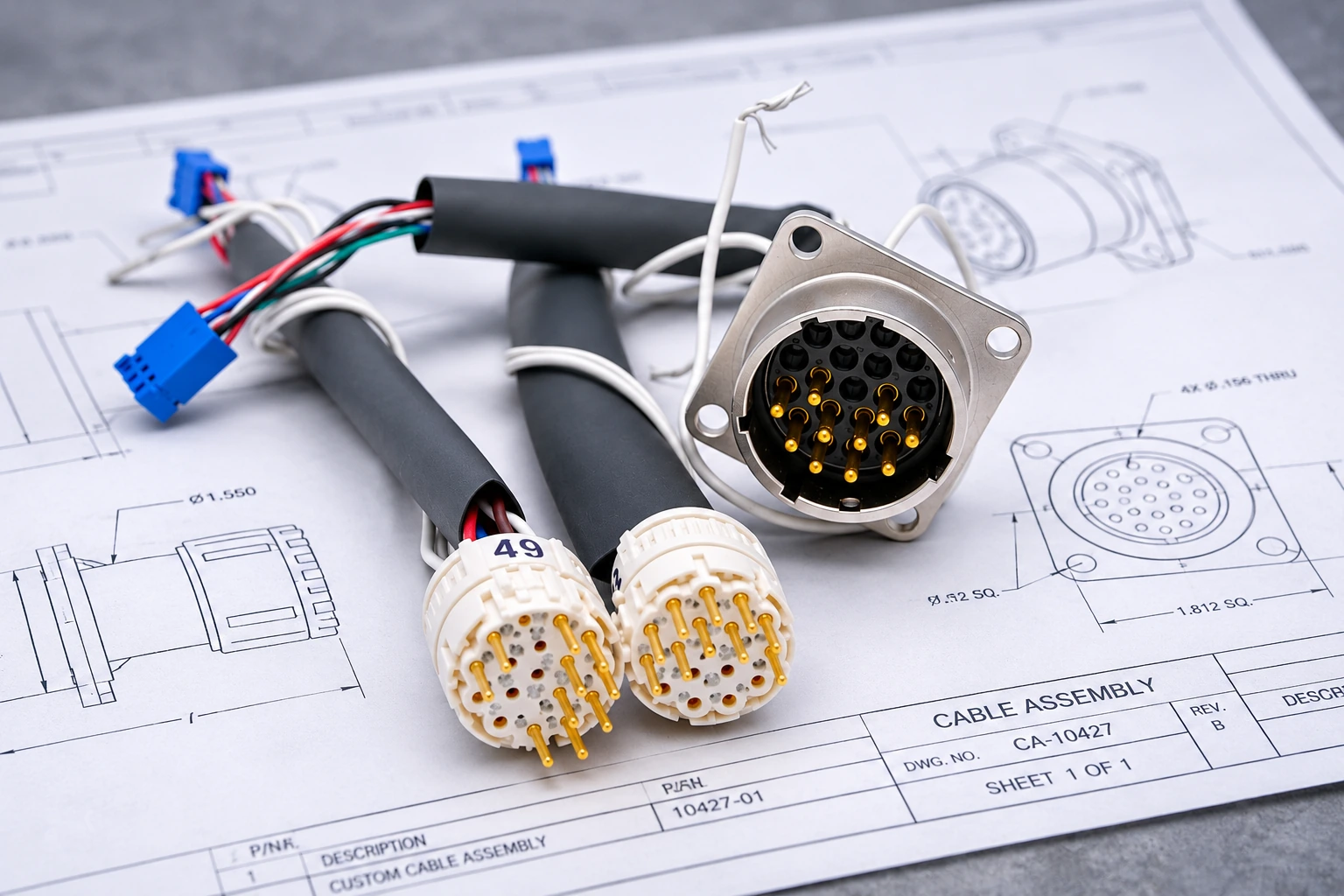
How to Choose a Defense Cable Assembly Manufacturer
The right defense cable assembly manufacturer must build to your drawings and specifications, provide the records your program requires, protect controlled information, and deliver on a schedule that keeps your program moving. Price matters, but it is only one factor in that decision.
These factors are easy to overlook once quotes arrive. Two suppliers can quote the same assembly yet price different work: one may include first article approval, material certifications, and test records, while another leaves them out or assumes equivalent components are acceptable.
To choose a defense or military cable assembly manufacturer, start by evaluating six factors: how completely the supplier can quote your RFQ package, whether its certifications and registrations cover your work, its experience with similar assemblies, how it will verify and document the build, how it manages sourcing and schedule risk, and whether its quote covers the same scope as the others. The steps below explain what to ask at each point.
1. Verify Supplier Qualifications Against Your Requirements
- A list of certifications and registrations is a starting point. Ask what each credential covers, whether it is current, and whether its scope includes the work you are quoting. A company’s credential alone does not by itself show that a particular assembly meets your program’s requirements.
- Quality management certifications: Request current certificates for ISO 9001 or AS9100 when applicable and review their scope. MJM Industries is ISO 9001:2015 certified. It has an internal, documented AS9100 compliance system to support customer requirements, but it is not AS9100 certified.
- Workmanship standards: Ask which standards the manufacturer builds to. IPC/WHMA-A-620 sets requirements and acceptance criteria for cable and wire harness assemblies, and J-STD-001 covers soldered connections. Both standards define classes, and your drawing or contract should specify the required class and revision.
- ITAR registration: Where your program involves export-controlled work, verify the supplier’s registration under the International Traffic in Arms Regulations (ITAR). Ask how it stores and limits access to controlled technical data, including drawings viewed only through your secure systems. Registration is a regulatory requirement; it does not establish the quality of a particular assembly.
- Ownership: Ask whether the company has any foreign ownership, control, or influence. This can affect access to export-controlled information.
- Cybersecurity: If your contract includes Cybersecurity Maturity Model Certification (CMMC) requirements, ask which level the supplier has achieved and how it protects the information you share.
- Supplier identification: A Commercial and Government Entity (CAGE) code is a five-character identifier assigned to a specific facility. It confirms who and where the supplier is, not what it can build.
2. Give Suppliers a Clear RFQ Package
Two suppliers can quote the same drawing and include different work, like first article inspection or test records. To compare quotes accurately, provide a request for quotation (RFQ) that specifies:
- Component and material specifications: Wire, cable, connectors, molding materials, and epoxy types, including whether equivalent components are acceptable.
- Electrical connections: A pinout matrix or other documentation defining the wiring.
- Operating conditions: Environmental and performance requirements.
- Applicable standards and flow-down requirements: Referenced specifications, workmanship requirements, and requirements your contract passes down to suppliers.
- Approval and documentation requirements: First article inspection, production part approval process (PPAP) submissions if required, material and finished-assembly certificates of conformance, and test records.
- Purchasing responsibilities: Customer-supplied parts, tooling, ownership and responsibility for other nonrecurring engineering (NRE) charges.
- Packaging and labeling: Requirements for identifying, packing, and shipping finished assemblies.
Highlight critical dimensions that affect installation or function. Wire and heat-shrink tubing can each meet their dimensional specifications yet produce a finished diameter that exceeds the assembly drawing’s limit. Reviewing how those tolerances stack up during quoting helps flag potential fit issues before production.
Label undecided requirements as open items so suppliers can address them rather than make assumptions.
The RFQ is also the point to confirm whether you need a custom assembly. A standard product may work if its specifications and available documentation meet your requirements. Custom manufacturing becomes necessary when the configuration, materials, dimensions, or verification requirements call for something different.
3. Evaluate Defense Cable Manufacturing and Engineering Experience
Ask prospective suppliers about assemblies with similar construction, materials, or operating conditions. Experience with a comparable connector, termination method, or environment tells you more than a general statement about serving the defense industry.
Useful questions include:
- Have you built assemblies using similar connectors, shielding, materials, or protective features?
- Which required processes and tests do you perform in-house, and which depend on outside partners?
- What engineering review takes place before a design enters production?
- How do you support first articles, production ramp-up, and planned releases?
Confidentiality may limit what a manufacturer can share before a mutual nondisclosure agreement is in place, but it should still be able to describe a relevant problem, its approach, and the result.
In most defense programs, the customer’s engineers own the design. The manufacturer’s role is to identify production requirements, such as wire preparation, routing, or termination access, and propose changes for your approval.
MJM Industries has also designed molds in-house for several military-style circular connector overmolds, with local partners fabricating the steel tools. Whether existing tooling fits a new project depends on the connector, dimensions, and tooling ownership.
4. Review Cable Assembly Testing and Quality Control
Your drawing, contract, and specifications determine which tests your assembly receives and what records come with it. Ask the manufacturer if they can complete the required tests. At MJM industries, we test every assembly individually. Specific tests depend on the build requirements.
If serialization is required, establish how each unit will be identified and linked to its test results. A part number identifies a design; a serial number identifies an individual unit.
Also ask whether the supplier can trace a finished assembly back to the material lots used to build it. If a material or quality issue appears later, that paper trail lets both teams find the affected assemblies and their supporting records.
5. Examine Cable Assembly Sourcing and Production Plans
A quoted lead time is only as reliable as the material availability and production capacity behind it. Ask where critical components come from, which have long lead times or obsolescence risk, and how those risks are reflected in the schedule.
The conversation should also cover the suppliers behind your assembly: how secondary sources are qualified, how often suppliers are audited or evaluated, and what would cause a supplier to be placed on hold or removed from the approved list. If a specified component becomes unavailable, establish how alternatives will be reviewed and approved before they are used.
Clarify where manufacturing occurs and whether your component sourcing meets any domestic content requirements in your contract. A U.S. manufacturing location does not, by itself, answer every question about material origin or outside processing.
Then map the path to production. Identify any tooling, samples, first article approval, or other steps that must be completed before a production release, and how each affects the delivery schedule. Ask how the supplier will report a schedule risk or a proposed change, and how often you will receive production updates.
6. Compare Defense Cable Assembly Manufacturers and Quotes
Use the same requirements to evaluate each supplier’s capabilities and quoted scope. Request supporting evidence and resolve differences before making your selection.
How to Evaluate a Cable Assembly Supplier
| What to check | What to ask for | How to verify it |
|---|---|---|
| Relevant experience | Examples involving similar connectors, materials, or operating conditions | Confirm which processes the supplier performed and how the work relates to your assembly |
| Qualifications | Current certificates and applicable registrations | Check expiration dates and confirm the scope covers the facility and work involved |
| Materials and sourcing | Quoted components, proposed equivalents, customer-supplied parts, and sourcing plans | Compare against your bill of materials and confirm approval requirements for substitutions |
| Engineering and tooling | Included engineering support, NRE charges, tooling ownership, and outside processing | Confirm responsibilities and how proposed design or process changes receive your approval |
| Testing and quality controls | A sample test report, calibration records, and an explanation of revision and nonconformance controls | Match the proposed checks to your specifications and confirm how equipment and drawing revisions are controlled |
| Documentation and traceability | Sample certificates of conformance and records linking assemblies to materials and test results | Confirm the records provide the traceability your contract requires |
| Production and delivery | Quantities, planned releases, lead times, and any first article or PPAP approval steps | Confirm the schedule accounts for material availability, capacity, and required approvals |
| Assumptions and exclusions | Written clarification of anything omitted, unresolved, or interpreted differently | Resolve discrepancies against your RFQ and obtain an updated quote where needed |
A lower price may reflect a different material assumption or missing documentation. Confirm those differences in writing so your decision reflects the full scope of work.
Frequently Asked Questions
What certifications should a defense cable assembly manufacturer have?
It depends on the program. ISO 9001 is a common quality management baseline, and some contracts require AS9100. Work involving defense articles or export-controlled technical data typically requires ITAR registration, and contracts may also specify CMMC requirements and workmanship standards such as IPC/WHMA-A-620.
Is ITAR registration the same as ITAR certification?
No. There is no ITAR certification. Registration with the U.S. Department of State’s Directorate of Defense Trade Controls is a regulatory requirement for companies that manufacture or export defense articles, and it does not certify the quality of a supplier’s products.
What does “military grade” mean for cable assemblies?
“Military grade” is not a single specification or certification. An assembly’s requirements come from your drawing, contract, and the military specifications they reference, so ask suppliers how they will meet those specific requirements.
Working With MJM Industries on a Defense Program
MJM Industries is an ITAR-registered U.S. manufacturer of custom cable assemblies, wire harnesses, and overmolded assemblies. Its team builds to IPC/WHMA-A-620 and J-STD-001 workmanship standards and uses laser wire stripping where conductor damage is a concern.
MJM Industries engineers review your drawings and specifications to identify manufacturing issues before production. The team designs overmold tooling in-house, works with local partners on steel-tool fabrication, and uses 3D printing to build production fixtures that keep assemblies consistent from first article through planned production releases. We test and document assemblies to the requirements in your drawings and contract, maintaining lot-level material traceability through our internal AS9100 compliance system.
The process starts with your program: what the assembly must do, how it must be built, and what evidence you need with the finished product. Share your drawings, specifications, documentation requirements, and production plans with MJM Industries to discuss whether its capabilities fit your application.